Others
Photographer Saw This Alien-looking Thing in Antarctica and his Jaw Just Dropped.
They are a stunning insight into an almost alien world.

Last month, designer and filmmaker Alex Cornell went to Antarctica on an expedition. He’s already a seasoned traveler and photographer, so he’s used to seeing awesome things during his trips. But even a man who’s used to seeing so much beauty got stunned with what he saw while cruising the frigid waters.
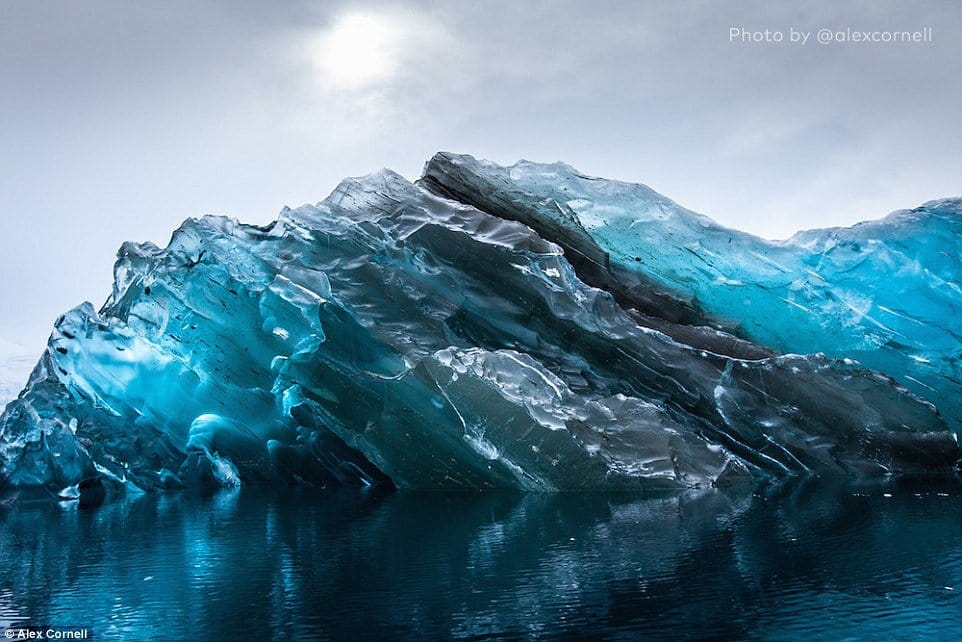
Resembling a big-ass Kryptonite in the middle of the ocean is a flipped iceberg, its polished crystal blue surface gleaming in the sunlight.
Seeing an iceberg is one thing, but seeing a flipped one is definitely more major since it’s a very rare occurrence. Most of the icebergs we see in pictures are snowy white but what Alex saw has a sparking azure color that makes it look like a giant galactic artifact. Experts say that the iceberg must be extremely ancient and its age could be anything from tens to thousands of years.
This ancient ice beast is a product of centuries of layered sediment and minerals.

Icebergs float because salt water is a lot denser compared to fresh water.

When an iceberg melts, the distribution of its weight changes, which can cause it to flip over. This is a rare occurrence though.
The penguins having fun in Iceberg Alley, found in the western part of Weddell Sea.

Icebergs can come in other shades aside from the usual pristine white.

(Continue reading next page…)
Flipping icebergs is not a common thing because of the size factor; ninety percent of an iceberg is hidden underwater so the chances of it turning over are as slim as an anorexic supermodel’s waist. But it’s not impossible, though. The weight distribution in an iceberg can change when they melt in the ocean, which can cause the big flip.
It looks like a big-ass Krytonite floating in the middle of the ocean.

Its polished blue surface gleamed in the sunlight, making it look like a chunk of galactic matter that just landed in the middle of Antarctica.

Icebergs flipping over happens rarely, but when it does… wow!
Alex Cornell took more amazing photos while he was travelling through the Drake Passage.

Drake Passage is located between the South Shetland Islands of Antarctica and the southern tip of South America at Cape Horn.
(Continue reading next page…)
Check out the stunning views at Cierva Cove.

These incredible iceberg photos were shot using Alex’s Canon 5D Mark II and 16-35mm f/2.8 lens.

A seal just chillin' in Cierva Cove.

According to Alex, "[It] is one of those places where you can point the camera in any direction and come away with something spectacular."

Truly, nature’s wonders will never cease!
H/T: Mail Online, Alex Cornell